
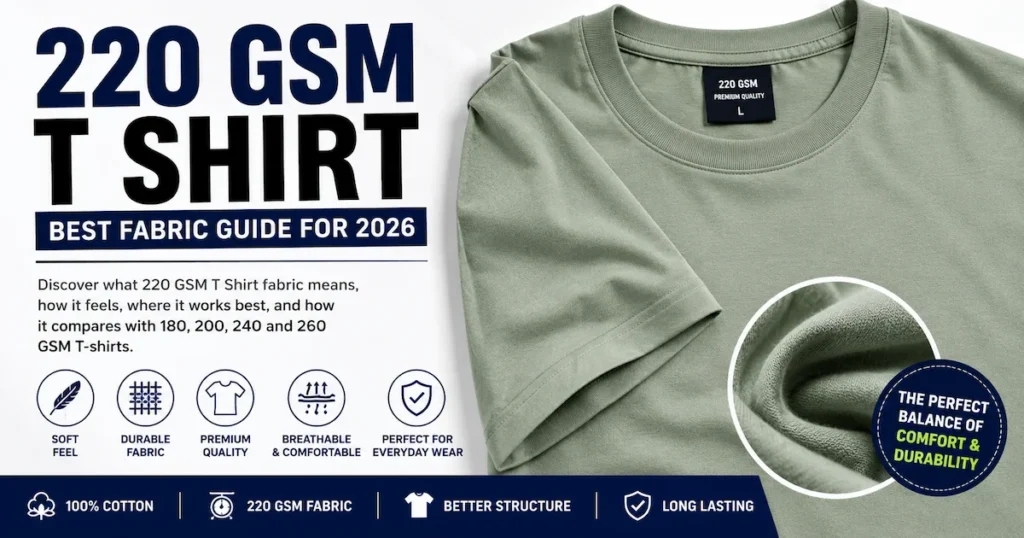
A 220 GSM T Shirt is a premium medium-heavy T-shirt made from fabric weighing approximately 220 grams per square meter. It sits between lighter 180–200 GSM fabrics and heavier 240–260 GSM heavyweight T-shirts, making it an excellent choice for people who want more structure, durability, and a premium feel without choosing an extremely heavy fabric.
GSM stands for grams per square meter and is one of the most useful measurements for comparing T-shirt fabric weight. A higher GSM generally means a denser and heavier fabric, while a lower GSM usually creates a lighter and more breathable garment.
For buyers looking for a balance between comfort and structure, a 220 GSM T Shirt can be an excellent middle-ground option. It works particularly well for premium casual clothing, relaxed fits, printed T-shirts, oversized styles, and modern streetwear.
What Does 220 GSM Mean in a T-Shirt?
The term 220 GSM T Shirt refers to the weight of the fabric rather than the total weight of the finished garment.
GSM means grams per square meter. Therefore, 220 GSM means that one square meter of the fabric weighs approximately 220 grams.
This measurement makes it easier to compare different T-shirt fabrics:
- 160 GSM = lightweight fabric
- 180 GSM = lightweight to medium fabric
- 200 GSM = medium-heavy fabric
- 220 GSM = heavier medium-weight fabric
- 240 GSM = heavyweight fabric
- 260 GSM = very heavyweight fabric
However, GSM should not be treated as a complete measurement of quality. Two fabrics with the same GSM can feel completely different depending on cotton quality, yarn construction, knitting method, finishing, and fabric composition.
A premium 220 GSM combed cotton fabric can feel considerably softer and more comfortable than a poorly manufactured fabric with the same weight.
Is 220 GSM Good for a T-Shirt?
Yes. A 220 GSM T Shirt is a very good choice for people who want more thickness and structure than a typical 160–180 GSM T-shirt without moving into very heavy 240–260 GSM territory.
A 220 GSM fabric can provide:
- Better structure than lightweight fabrics
- A more substantial hand feel
- Good durability
- Better coverage
- Reduced transparency
- Good support for printed designs
- Comfortable everyday wear
- Excellent suitability for relaxed and oversized fits
The versatility of 220 GSM makes it useful for both everyday premium clothing and fashion-focused collections.
If you want a broader explanation of how fabric weight affects T-shirt performance, see our Complete GSM Guide for T Shirts.
A 220 GSM T Shirt offers a practical balance of fabric weight, structure, comfort, and durability, making it suitable for premium everyday wear, relaxed fits, and modern streetwear.
How Does a 220 GSM T Shirt Feel?
A 220 GSM T Shirt normally feels noticeably thicker and more structured than a 160 or 180 GSM T-shirt.
Compared with 200 GSM, the difference is present but usually not dramatic. A 220 GSM fabric simply provides a little more body, weight, and structure.
A good-quality 220 GSM cotton T-shirt can feel:
- Soft
- Smooth
- Dense
- Structured
- Premium
- Durable
- Comfortable for regular wear
The final feel depends heavily on fabric construction.
CottonWorks explains knit construction and how knitted fabrics can vary in flexibility, texture, stretch, and performance. This is one reason GSM should be considered together with construction rather than used as the only quality measurement.
220 GSM vs 180 GSM T Shirt
The difference between a 220 GSM T Shirt and an 180 GSM T-shirt is easy to notice.
An 180 GSM T-shirt is lighter and generally more breathable, while 220 GSM provides greater thickness, structure, and coverage.
| Feature | 180 GSM | 220 GSM |
|---|---|---|
| Fabric Weight | Lightweight | Medium-heavy |
| Breathability | Excellent | Good |
| Structure | Moderate | Very Good |
| Durability | Good | Very Good |
| Coverage | Moderate | Better |
| Summer Comfort | Excellent | Good |
| Premium Feel | Good | Very Good |
| Streetwear Suitability | Good | Excellent |
If maximum lightness and breathability are the priority, 180 GSM can be a better choice.
If you want more structure and a premium substantial feel, 220 GSM offers a stronger option.
220 GSM vs 200 GSM T Shirt
The difference between 200 GSM and 220 GSM is relatively small compared with the difference between lightweight and heavyweight fabrics.
A 220 GSM T-shirt generally feels slightly denser, heavier, and more structured than a 200 GSM T-shirt.
Choose 200 GSM when you want:
- Everyday versatility
- Moderate thickness
- Good breathability
- Easy layering
- Premium casual wear
Choose 220 GSM when you want:
- More fabric structure
- A slightly heavier hand feel
- Better support for oversized silhouettes
- A more substantial appearance
- Greater coverage
For many buyers, the 200–220 GSM range is one of the most useful ranges for premium everyday T-shirts.
220 GSM vs 240 GSM T Shirt
A 240 GSM T-shirt is heavier and more structured than a 220 GSM T Shirt.
The difference becomes more noticeable when the fabrics are compared side by side.
| Feature | 220 GSM | 240 GSM |
|---|---|---|
| Weight | Medium-heavy | Heavyweight |
| Breathability | Good | Moderate |
| Structure | Very Good | Excellent |
| Comfort | Very Good | Good |
| Oversized Fit | Excellent | Excellent |
| Summer Use | Better | Less suitable |
| Heavyweight Feel | Moderate | Strong |
| Streetwear Appeal | High | Very High |
If you want premium streetwear with strong structure but still want reasonable versatility, 220 GSM can be a practical choice.
If you specifically want a heavyweight oversized appearance with stronger drape and density, 240 GSM may be more suitable.
You can also compare this with our 180 GSM vs 240 GSM T Shirts guide for a broader lightweight-versus-heavyweight comparison.
Is 220 GSM Good for Oversized T-Shirts?
Yes. A 220 GSM T Shirt can work extremely well for oversized T-shirts.
It provides enough body to support a relaxed silhouette while remaining more wearable than some extremely heavyweight fabrics.
The final oversized appearance does not depend on GSM alone.
Important factors include:
- Shoulder width
- Body length
- Sleeve length
- Fabric composition
- Pattern construction
- Neck rib thickness
- Fabric finishing
A carefully designed oversized T-shirt made from 220 GSM cotton can create a premium silhouette without becoming unnecessarily heavy.
For buyers specifically interested in oversized fabric weights, our Best GSM for Oversized T Shirts guide covers different GSM options for oversized styles.
Is 220 GSM Good for Summer?
A 220 GSM T Shirt can be worn during summer, but the answer depends strongly on climate, humidity, fabric construction, and personal preference.
In mild or dry weather, breathable 220 GSM cotton can remain comfortable.
In extremely hot and humid conditions, a lighter 160–180 GSM fabric will generally feel cooler.
A simple comparison is:
- 160–180 GSM = best for maximum lightness
- 200 GSM = balanced everyday option
- 220 GSM = more structure and substance
- 240–260 GSM = better for cooler conditions and heavyweight styling
Therefore, 220 GSM is not automatically too heavy for warm weather. Fabric composition, knitting, finishing, and airflow all influence comfort.
Is 220 GSM Good for Printing?
Yes. A 220 GSM T Shirt can be an excellent choice for printed clothing because the fabric provides a stable and substantial surface for graphics.
It can work well with:
- DTF printing
- Screen printing
- DTG printing
- Heat-transfer printing
The slightly heavier fabric can help create a premium appearance, especially for streetwear graphics and larger printed designs.
However, final print quality depends on much more than GSM. Transfer quality, ink, pretreatment, curing, artwork resolution, garment composition, and application technique all influence the finished result.
Is 220 GSM Good for Premium T-Shirts?
Yes, but GSM alone does not make a T-shirt premium.
A premium 220 GSM T Shirt should combine suitable fabric weight with good cotton, yarn construction, knitting, finishing, stitching, and garment design.
A premium 220 GSM T-shirt may include:
- High-quality cotton
- Combed or compact yarn
- Consistent knitting
- Soft finishing
- Strong stitching
- Good neck rib construction
- Accurate sizing
- Proper garment washing
- High-quality printing
A poorly manufactured 220 GSM fabric can still feel rough, stiff, or uncomfortable.
This is why buyers should evaluate the complete garment rather than selecting a T-shirt based only on the GSM number.
What Fabric Is Best for a 220 GSM T Shirt?
Cotton is one of the most popular choices for a 220 GSM T Shirt, particularly when softness, breathability, durability, and everyday comfort are important.
220 GSM Combed Cotton
Combed cotton is processed to remove many shorter fibres, helping create a smoother and more consistent yarn.
It can provide:
- Better softness
- A cleaner surface
- Better comfort
- More premium appearance
220 GSM Compact Cotton
Compact yarn construction can produce a smoother and denser fabric surface.
This can be useful for premium basics, oversized T-shirts, and printed clothing where a clean surface is desirable.
220 GSM Cotton Blend
Cotton blends can introduce additional properties such as stretch, durability, or moisture management depending on the fibres used.
The best option depends on the intended product rather than GSM alone.
Does Higher GSM Mean Better Quality?
No.
Higher GSM means more fabric weight per square meter, but it does not automatically mean better quality.
For example, a high-quality 180 GSM combed cotton T-shirt can be softer and more comfortable than a poorly manufactured 240 GSM garment.
Quality depends on multiple factors:
- Fibre quality
- Yarn quality
- Fabric construction
- GSM
- Finishing
- Stitching
- Garment construction
- Washing process
GSM should therefore be considered one part of the overall quality equation.
What Is the Best GSM for Everyday T-Shirts?
There is no single GSM that is perfect for every person.
For everyday clothing, approximately 180–220 GSM provides a useful range.
A 220 GSM T Shirt is particularly suitable for buyers who want more structure and substance while still maintaining practical everyday wearability.
For extremely hot climates, lighter fabrics may be more comfortable.
For winter layering or heavyweight streetwear, 240–260 GSM may be more suitable.
What Is the Best GSM for Streetwear?
For streetwear, the ideal GSM depends on the silhouette, climate, design, and desired level of structure.
Lightweight streetwear can work well around 180 GSM, while premium oversized styles often use 220–260 GSM.
A 220 GSM T Shirt can be a strong choice when you want a structured oversized design without the extremely heavy feel of some heavyweight streetwear fabrics.
The pattern is equally important. A well-designed oversized T-shirt in 220 GSM fabric can create a strong streetwear silhouette while remaining relatively versatile.
220 GSM T Shirt for Clothing Brands
For clothing brands, 220 GSM can be an attractive fabric weight because it balances several product requirements.
A brand can use 220 GSM for:
- Premium basic T-shirts
- Printed T-shirts
- Relaxed-fit T-shirts
- Oversized styles
- Casual collections
- Premium streetwear
- Graphic T-shirts
The same fabric weight can work across multiple designs, which can simplify product development.
However, brands should test:
- Fabric shrinkage
- Colour fastness
- Stitching
- Print performance
- Sizing consistency
- Wash durability
- Fabric recovery
before committing to large production quantities.
How to Choose a Good 220 GSM T Shirt
When buying a 220 GSM T Shirt, do not look at the GSM number alone.
1. Fabric Composition
Check whether the garment uses cotton, a cotton blend, or another fibre.
Fibre composition can significantly affect softness, breathability, durability, and comfort.
2. Fabric Feel
Touch the fabric and check whether it feels smooth, dense, soft, and comfortable rather than rough or excessively stiff.
3. Stitching
Inspect shoulder seams, sleeve seams, side seams, and the bottom hem.
Consistent stitching is important for long-term garment durability.
4. Neck Rib
A good neck rib should maintain its shape instead of becoming loose quickly after repeated wear and washing.
5. Fit
Check shoulder width, body length, sleeve length, and overall silhouette.
A high-quality fabric cannot compensate for poor pattern construction.
6. Shrinkage
Cotton garments can shrink after washing.
Proper finishing and pre-shrunk fabrics can help reduce unexpected changes in size.
7. Printing
If purchasing a printed T-shirt, inspect the print for sharpness, coverage, surface consistency, and overall finish.
220 GSM T Shirt: Pros and Cons
Advantages
- Balanced heavyweight feel
- More structure than 160–180 GSM fabrics
- Good everyday comfort
- Strong durability
- Premium appearance
- Excellent choice for printing
- Works well for relaxed and oversized fits
- Less bulky than many 240–260 GSM fabrics
Disadvantages
- Can feel warmer than lightweight fabrics during extreme summer
- May be heavier than some buyers prefer
- Quality still depends on cotton and construction
- GSM alone cannot determine softness or durability
- May not provide the extremely heavyweight appearance of 240–260 GSM
Frequently Asked Questions About 220 GSM T Shirts
Is 220 GSM good for a T-shirt?
Yes. 220 GSM provides a strong balance between comfort, structure, durability, and premium appearance. It is particularly suitable for premium casual T-shirts, relaxed fits, and streetwear.
Is 220 GSM too thick for summer?
Not necessarily. A breathable 220 GSM cotton T-shirt can work well in moderate summer conditions. For extremely hot and humid weather, lighter 160–180 GSM fabrics may feel cooler.
Is 220 GSM considered heavyweight?
220 GSM is generally considered medium-heavy to heavyweight depending on the fabric and industry classification. Fabrics around 240–260 GSM are more commonly associated with heavyweight T-shirts and streetwear.
Is 220 GSM good for oversized T-shirts?
Yes. 220 GSM is an excellent choice for oversized T-shirts because it provides enough structure to support a relaxed silhouette while remaining more wearable than extremely heavy fabrics.
What is better, 200 GSM or 220 GSM?
200 GSM is slightly lighter and more versatile for everyday use, while 220 GSM provides more structure, substance, and premium feel. The better choice depends on climate, fit, and intended use.
What is better, 220 GSM or 240 GSM?
220 GSM is generally more versatile and easier to wear across different conditions. 240 GSM provides a heavier and more structured feel that is often preferred for heavyweight oversized streetwear.
Does 220 GSM mean good quality?
No. GSM measures fabric weight, not overall quality. Cotton quality, yarn construction, knitting, finishing, stitching, and garment manufacturing all influence the final quality.
Is 220 GSM good for DTF printing?
Yes. 220 GSM fabric can provide a stable surface for DTF printing and is suitable for many premium printed T-shirts. Final print quality depends on the garment, transfer quality, artwork, and application process.
Final Thoughts
A 220 GSM T Shirt is one of the most versatile choices for people who want more structure and substance than lightweight T-shirts without moving directly into very heavy 240–260 GSM fabrics.
It provides a strong balance between comfort, durability, breathability, structure, and premium appearance. For everyday premium wear, relaxed fits, printed clothing, oversized designs, and modern streetwear, 220 GSM can be an excellent fabric weight.
However, GSM should never be the only factor when choosing a T-shirt. Fabric composition, cotton quality, yarn construction, finishing, stitching, fit, and intended use all influence the final garment.
If you want a lightweight summer T-shirt, 160–180 GSM may be more suitable. If you want a versatile premium everyday T-shirt, 200 GSM can be an excellent middle ground. If you want additional structure and a premium substantial feel, 220 GSM T Shirt fabric is a strong choice. For an even heavier oversized streetwear appearance, 240–260 GSM may be more appropriate.
Understanding 220 GSM T Shirt fabric helps buyers compare products more intelligently and choose clothing based on actual fabric weight, construction, comfort, and intended use rather than relying on marketing claims alone.